

Red Archives
Experiments in mind, myth and machine.
Behind the music lies a search. The Red Archives collects what Revun finds along the way: philosophical ideas, psychological tests, and experiments with artificial life.
Each one is a way to look at the unconscious from another angle.
File 01: The Sigil
The Sigil
The first Revun sigil was never constructed. It was drawn. One circle, one vertical axis, and a set of points placed where they felt right: horns rising from a shield, a sword driven down through the centre, six sharp points reaching outward. No compass, no ruler. Intuition decided where every line would end.
Still, the question remained whether that hand had been following something older. Revun laid the drawing over the Seed of Life: seven circles of one radius, the pattern read as the first days of creation. Turned so that its star falls on the sword's axis, the Seed carries a perfect hexagram, one triangle rising and one descending. Above and below, spirit and matter, the union of opposites that Jung placed at the heart of becoming whole. The drawn points were already close. Top and bottom sat on the axis, and the six tips lay within about 3% of a single circle.
Version 2 closes the remaining gap. Every point is moved onto the geometry. The six tips now stand exactly 60° apart, the horns lock onto the same circle, and every line runs at a multiple of 30°. The tips turned by 6 to 8 degrees; on average a point moved about 8% of the radius.
Neither version corrects the other. The first is feel, the second is mathematics. Revun lives in the space between them: intuition discovering that it was following a structure all along.
File 02: From Music Frequencies to Visuals
Music > Visual
New Revun visuals start here: not with a camera or a prompt, but with the track itself.
These numbers become the instructions. The code reads them frame by frame and turns them into light, motion and form. Nothing is drawn by hand and nothing is generated by AI. What you see is the music, made visible.
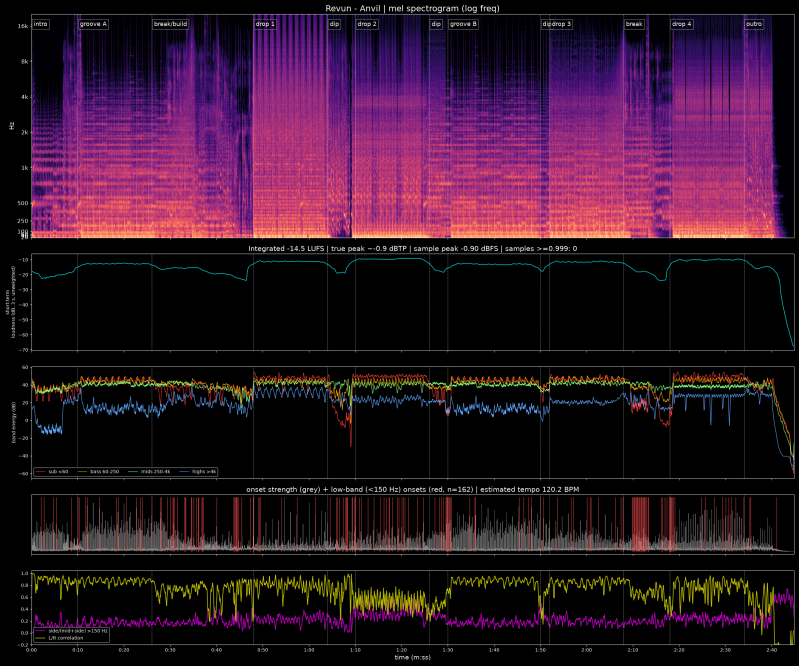
This is Anvil, broken down into data. The top layer is a spectrogram: time runs left to right, pitch rises from bottom to top, and brightness shows energy. You can read the song's structure in it directly, from the intro and grooves to the build and the four drops, with every dip and break in between.
Below it, the loudness curve shows how hard each section hits. The band energy splits the sound into sub, bass, mids and highs, so a visual can react differently to each: the sub can move mass, while the highs throw sparks. The onset line marks every individual hit, 162 low-end strikes at around 120 BPM. Those are the moments when something flashes, cracks or forges. At the bottom, stereo width and correlation show when the sound opens up and when it narrows.
File 03: Nagalm
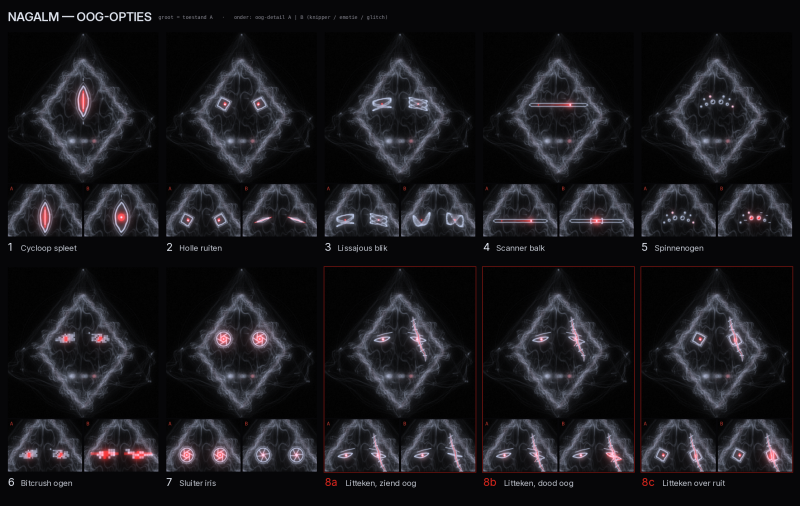
Nagalm is the companion that lives inside Revun's world: a small creature that watches, murmurs and listens back. Nothing about him was drawn by hand or generated by AI.
His face is pure code and mathematics: a diamond, two living triangle eyes that blink, narrow and flare, and a single red dot that moves as he speaks. His voice is synthesised from scratch, a croak, a curious "hm", a murmur in a language that doesn't exist, broken by small glitches.
The name is Dutch for afterglow of sound, the echo that keeps ringing after the note is gone. That is what he is: what remains of the music once it stops. A guide on the way down, with a shadow of his own, who knows that the deepest point of the descent is the moment you no longer need a guide.
File o4: Buckriders
In eighteenth-century Limburg and the Land van Overmaas, a name clung to the night: bokkenrijders (Buckriders). Folklore cast them as riders on flying goats, gifts of the Devil; once a year they answered him on the heath at Mook. An old charm still names the flight: over house, over garden, over stake — even to Cologne, into the wine cellar. Belief mattered less than fear.
The archive is sterner. Across Dutch and Belgian Limburg and toward Herzogenrath, robber bands struck farms and rectories from roughly the 1740s into the 1790s. Some used the Buckrider myth as cover. Courts answered with late witch-hunt logic. Prosecutions came in waves — mid-1740s, then again through the 1770s–1790s. Suspects faced an “ungodly oath”: God renounced, the Devil sworn. Confessions followed torture or its threat. Wikipedia’s synthesis puts the accused on the order of twelve hundred; English Wikipedia cites estimates of 425–468 executions (1743–1796). In 1774 attorney general Gaspard de Limpens already judged most of the condemned innocent.
Legend flies; the record hangs. Limburg was among the last European regions where a devil’s pact still fed mass trials. A plaque on Valkenburg’s former town hall later named the miscarriage of justice.
Revun’s track Buckriders : dark cinematic electronics, ravens and owls, a narrated thread, does not close the case. It reframes the accused as rebels against an elite that owned land and scaffold, and honours ancestors of the artist executed after such accusations. Names stay unspoken. The file remains open.

File 05: Sacred Geometry
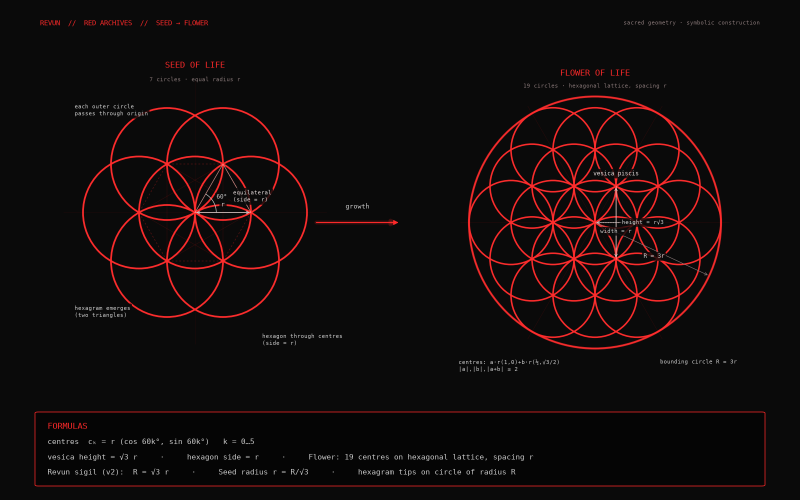
“Sacred geometry” is not a science. It is a symbolic and esoteric tradition: a habit of reading meaning into measure, and of treating form as a language for what words handle badly. Its vocabulary is familiar: Seed and Flower of Life (overlapping circles of one radius); the hexagram (two interlaced triangles, above meeting below); Metatron’s Cube; the five Platonic solids — the only regular convex polyhedra in three-space.
Greek thought already cared about this order. The Pythagorean tradition tied number to cosmos and harmony. In Plato’s Timaeus, the craftsman-god shapes the world with geometric means. The golden ratio studied in Luca Pacioli’s De divina proportione (1509), with illustrations associated with Leonardo — became another hinge between beauty and proportion. Kepler later nested the Platonic solids in his Mysterium Cosmographicum as a model of planetary spacing. None of this proves occult claims hung on these figures. It shows how persistently humans have used geometry as myth.
Sound enters through cymatics. A vibrating plate gathers sand into nodal patterns Chladni figures among the best-known. Physics explains the lines; the esoteric tradition hears a parable: vibration becoming visible form. That matters to electronic music.
Revun’s sigil is built from the Seed of Life and a hexagram; every line sits on a multiple of thirty degrees (see File 001).
His sound-to-image visuals push the same wager: frequency rendered as geometry. The Red Archives claim no revelation — only a method where mind, myth, and machine share one grid.